 Let's Read the Landmark Papers
This week's paper
Streamlined and on-demand preparation of mRNA products on a universal integrated platform
VS Code in the browser · the paper and its Korean edition · an AI to ask · a Python terminal
 1
1
🐧 Operating Systems, First Steps
Every student gets their own virtual Ubuntu 24.04 server, with an online store already installed on it. Over 20 lessons you run that store yourself — deploy it, kill it, cause a 502, and track the cause down in the logs.
- Part 1 Kernel and shell · the terminal · the file system · nano
- Part 2 Permissions · processes · virtual memory · pipes · shell scripts
- Part 3 apt · SSH · deployment · systemd · nginx · incident response · firewalls
 2
2
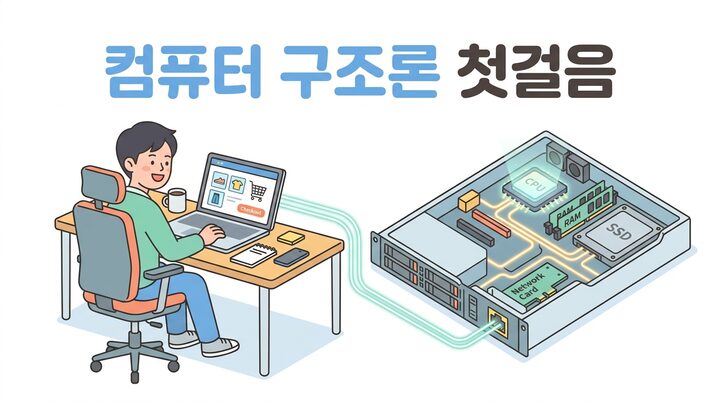
🖥️ Computer Architecture, First Steps
Start at a single bit and go through gates, the CPU, caches and virtual memory, all the way to diagnosing the bottleneck in a store server taking 300 orders a second. You drive a miniature CPU by hand along the way.
- Part 1 Bits · two's complement · logic gates · inside the CPU · machine code
- Part 2 The memory hierarchy · caches · pages and the TLB · pipelining · IOPS
- Part 3 A three-minute performance triage · OOM · tuning workers · Black Friday
 3
3
🌐 Computer Networks, First Steps
Configure a server yourself on a virtual network simulator. Pin a static IP, open the firewall, install a certificate, and corner the cause of a 502 by cutting the problem layer by layer.
- Part 1 Packets · IP and CIDR · routing and ARP · TCP/UDP · DNS · HTTP
- Part 2 netplan · ufw · NGINX · HTTPS · reverse proxies · redundancy
- Part 3 The four golden signals · fault diagnosis · rate limiting · performance tuning
 4
4
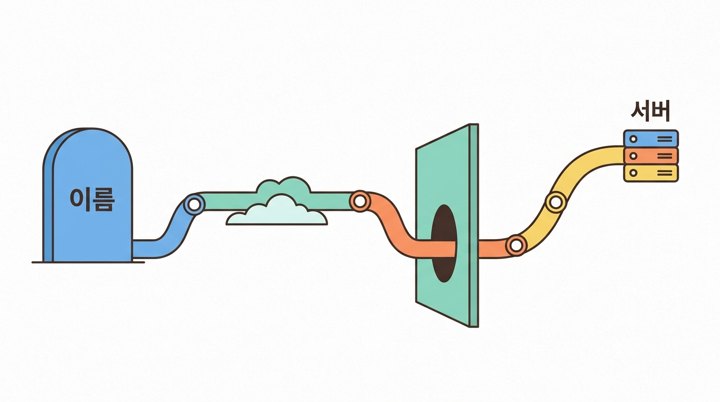
🏷️ Domain Management, First Steps
Why does typing a name bring up your server? These lessons open the five gates in between — DNS, the proxy, the lock, the tunnel and nginx. At the end you publish a new service on a server that has no public IP and no open ports.
- Part 1 Anatomy of a name · recursive resolution · registrars and expiry · five record types · TTL
- Part 2 Cloudflare · A records · the proxy · the TLS handshake · SSL modes · origin certificates
- Part 3 NAT and CGNAT · cloudflared tunnels · API tokens · reverse proxies · server_name · triage
 5
5
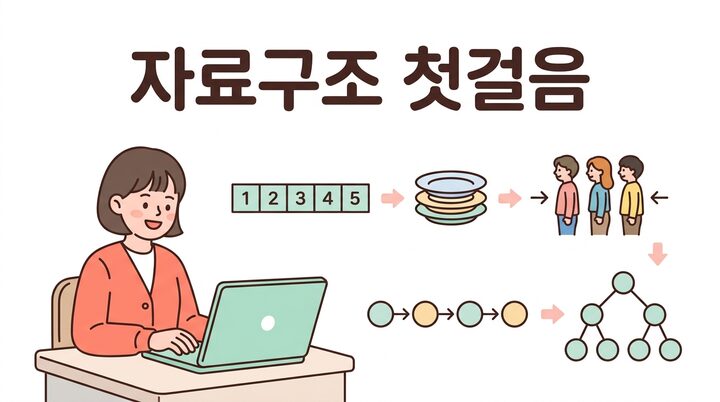
🧱 Data Structures, First Steps
Start with a single variable and build every container for data in turn — stacks, queues, trees, graphs. Every line of Python runs right in the browser through Pyodide.
- Part 1 Lists · dictionaries · stacks · queues and deques · linked lists · trees and BSTs
- Part 2 Heaps · hash tables · graphs · BFS/DFS · five sorts · escaping a maze
- Part 3 Big-O time complexity · how to pick the right structure
 6
6
🧭 Algorithms, First Steps
Every example starts from a real situation in running an online store. Pull the top ten sellers, optimise coupons, throttle traffic, and compute p99 latency from the logs.
- Part 1 Cost and Big-O · linear search · binary search (= the DB index)
- Part 2 Five sorts · killing N+1 with a hash · top-N · greedy · dynamic programming
- Part 3 Graphs and Dijkstra · LRU caches · token buckets · anomaly detection · log analysis
 7
7
🗄️ Databases, First Steps
Start from a variable and go all the way to building and deploying an online store with SQLite3, Flask, Jinja2 and Bootstrap. Your SQL runs against a private sandbox database of your own.
- Part 1 Records · CRUD · tables · indexes · joins and normalisation · transactions
- Part 2 SQLite3 → Flask → Jinja2 → Bootstrap · an e-commerce capstone
- Part 3 Domains and DNS · HTTPS certificates · NGINX · tunnelling through NAT · operations
 8
8
🔐 Information & Network Security, First Steps
Instead of only reading about it, you run the attack, watch it work, and then close the hole. Every student gets a virtual server, and the attack commands run safely — no real traffic leaves the page.
- Part 1 Threat models · reconnaissance · firewalls · hashes · ciphers · certificates
- Part 2 Brute force · eavesdropping · privilege · hardening SSH · fail2ban · DDoS
- Part 3 SQL injection · XSS · uploads · sessions · logs · incident response · a checklist
 9
9
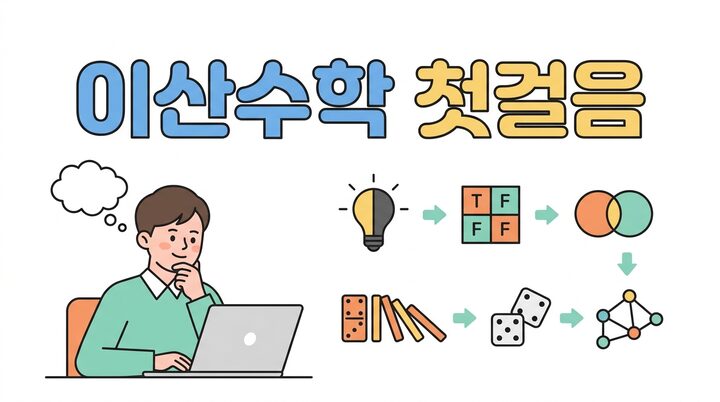
🔢 Discrete Mathematics, First Steps
The mathematics computers actually use. Starting from true and false, you work through truth tables, sets, relations, functions, induction, permutations and combinations, probability, number theory and graphs — counting by hand, then checking with Python. You run RSA and Euler paths yourself.
- Part 1 Propositions · truth tables · conditionals · Boolean algebra · quantifiers · proof techniques
- Part 2 Sets and operations · relations · functions · induction · recurrences
- Part 3 Counting rules · permutations and combinations · pigeonhole · inclusion–exclusion · probability · number theory · graphs
 10
10
🐍 Python, First Steps
Python for people who do biology. Start with variables and lists, read a FASTA, filter tables with pandas, draw volcano plots and heatmaps, and then reproduce the 11,070 to 3,055 sample selection of the 2025 PNAS DDX54 paper.
- Part 1 Values and names · strings and sequences · lists · dictionaries · conditions · functions
- Part 2 FASTA · CSV and TSV · numpy · pandas · merge and groupby · matplotlib
- Part 3 log2 · t-tests · volcano plots · heatmaps · reading errors · reproducing the paper
 11
11
⚗️ Chemistry for Bioinformatics, First Steps
/bio and /gene use DDX54 as a name. These 20 lessons open up what is behind it — DEAD is four amino acids, the p- is a phosphate carrying charge −2, and CD38 is the enzyme that cleaves NAD⁺.
- Part 1 Atoms and bonds · water and the hydrophobic effect · pH and pKa · buffers · the four biomolecules
- Part 2 Nucleotides · the 2′-OH and DV200 · base pairs and Tm · amino acids · folding · enzymes
- Part 3 ATP and DEAD-box · phosphorylation · NAD⁺ and CD38 · adenosine · antibodies · the chemistry of mutation
 12
12
🧬 Bioinformatics, First Steps
Don't take the paper's word for it — recompute it yourself. A 2025 PNAS paper named DDX54 as the commander behind immune evasion in lung cancer. You rerun its central experiment from scratch on the real raw data from NCBI GEO: normalisation, statistics and pathway analysis by your own hand, without peeking at the authors' answer.
- Part 1 Raw RNA-seq · GEO · pandas · numpy axes and broadcasting
- Part 2 CPM normalisation · log2 · verifying the knockdown · filtering low expression
- Part 3 log2FC · limma's empirical Bayes · the moderated t · volcano plots · GSEA · the reproducibility verdict
 13
13
📐 Linear Algebra, First Steps
The mathematics that computer graphics, machine learning and search all stand on. From a single arrow you reach matrices, linear maps, determinants, Gaussian elimination, basis and dimension, projection, least squares, eigenvalues and the SVD — warping the grid with your own hands and checking the result in Python.
- Part 1 Vectors · linear combinations · the dot product · matrices · matrix × vector · linear maps · matrix products
- Part 2 Determinants · inverses · linear systems · Gaussian elimination · rank · subspaces · basis · the null space
- Part 3 Projection · least squares · eigenvalues · diagonalisation · the SVD
 14
14
🎲 Probability and Statistics, First Steps
Statistics answers one question — could a difference this big be nothing but chance?
These twenty lessons lay the foundation that fifteen courses on this site each had to lay again: null distributions and p-values, power and confidence intervals, permutation tests and the bootstrap, multiplicity and FDR, and finally the cases where the arithmetic is right and the sentence is wrong. The examples are not invented — 566 TCGA-LUAD patients, 347 miRNAs, 5,202 slides.
- Part 1 What chance is · probability · distributions and skew · sampling · the central limit theorem
- Part 2 Standard error and confidence intervals · null distributions · p-values · power and the winner's curse
- Part 3 Choosing a test · permutation tests · the bootstrap · multiple testing · FDR
- Part 4 Survival and censoring · regression and adjustment · confounding and Simpson's paradox · putting it together
 15
15
🤖 Machine Learning, First Steps
/stat asks whether a difference is chance. These twenty lessons ask something else — does it hold on data you have not seen?
The standard of success differs, and so do the ways you get fooled. You can produce AUC 0.9 from data with no signal at all — just select the features first. Overfitting, leakage, imbalance, thresholds and reading importance as cause: five traps, turned by hand. Built in numpy, no scikit-learn.
- Part 1 Inference vs prediction · four tasks · features and scaling · splitting · overfitting
- Part 2 Cross-validation · when accuracy lies · ROC and AUC · thresholds · calibration
- Part 3 Linear models and regularisation · trees and forests · neighbours · PCA · clustering
- Part 4 Leakage · imbalance · the trap of importance · putting it together · what you may say
 16
16
🧠 Deep Learning, First Steps
/ml lesson 11 ended with try a linear model first. These twenty lessons are what comes next.
Start from four points no line can separate, write backpropagation by hand, build attention in six lines, and see how AlphaFold reached 92.4 at CASP14. No PyTorch — you only understand the inside once you have written it. The last lesson asks when not to use deep learning at all.
- Part 1 What a line cannot do · one neuron · stacking layers · backpropagation · learning rate
- Part 2 Vanishing gradients · minibatches · early stopping and dropout · normalisation · tuning
- Part 3 Convolution · limits of sequences · attention · transformers · pretraining and transfer
- Part 4 Proteins and AlphaFold · slides and cells · shortcut learning · putting it together · when not to
 17
17
🐍 VIPER, First Steps
What actually drives a cancer is not DNA but protein — and protein activity is hard to measure. VIPER listens to the murmur of a protein's subordinate genes and works backwards to what that protein is doing, on the map of connections ARACNe drew. You build the paper's formula one term at a time.
- Part 1 Protein activity · regulons · ARACNe · mode of regulation · confidence weights
- Part 2 Signatures · rank transforms · enrichment · normal quantiles · aREA · NES · the null distribution
- Part 3 msVIPER · metaVIPER · single cell · shadow effects · master regulators · checkpoints · drug targets
 18
18
🕵️ DIGGIT, First Steps
If VIPER caught the power broker on the ground, DIGGIT tracks down the genomic alteration pulling that broker's strings. Where correlation used to stop, you learn to link the chain of causation — writing it yourself, from mutual information through to permutation testing.
- Part 1 Drivers and passengers · the three-stage pipeline · the limits of GWAS · kinds of alteration · F-CNV
- Part 2 Mutual information · regulons · VIPER activity · signatures · master regulators
- Part 3 aQTL · statistical power · permutation tests · FDR · MINDy · conditional analysis · integrating evidence · KLHL9
 19
19
🕸️ Hunting for the Gene, First Steps
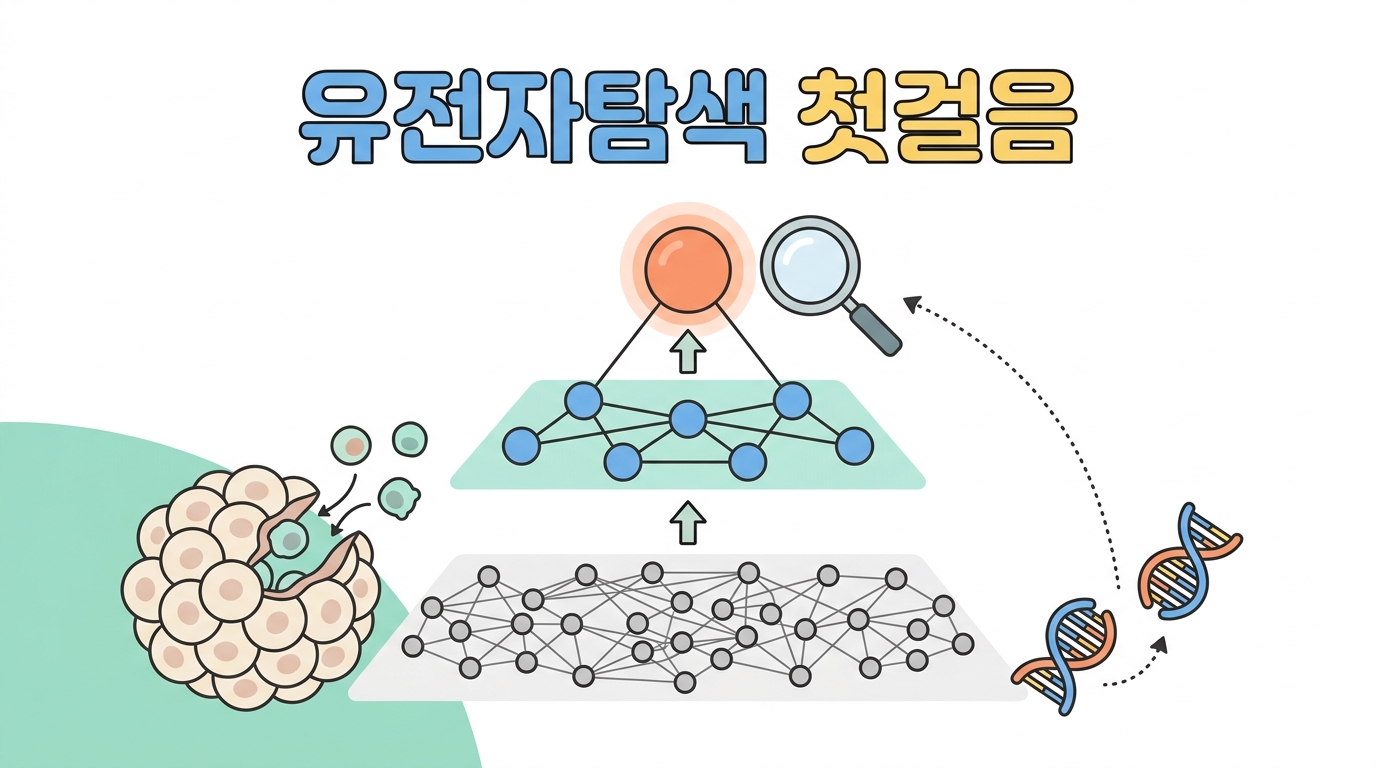
ARACNe, VIPER and DIGGIT, end to end. A KAIST team led by Prof. Kwang-Hyun Cho showed that lung cancer cells disguise themselves as fetal tissue to slip past the immune system. You rerun their three-stage network analysis yourself on public TCGA raw data and arrive at the master regulator DDX54.
- Part 1 The immune-desert paradox · selecting TCGA samples · TMB · the immune-desert signature
- Part 2 Mutual information · the ARACNe network · DPI · regulons · inferring VIPER activity · aREA
- Part 3 DIGGIT · F-CNV · MINDy · the regulator score · knockdown validation · in vivo · the reproducibility verdict
 20
20
🕸️ ARACNe, First Steps
Where do VIPER's regulons come from? ARACNe recovers the whole web of genes from expression data alone. Rather than downloading somebody's program, you write it yourself starting from one line of entropy — and grade it against a simulated cohort whose right answer you already know.
- Part 1 Transcription factors and targets · where correlation fails · entropy · mutual information
- Part 2 Binning and bias · rank transforms · the MI matrix · the null-distribution threshold
- Part 3 The data processing inequality · tolerance · bootstrap consensus · regulons · VIPER · pitfalls and validation
 21
21
🧫 Bioinformatics Datasets, First Steps
The figures in a paper come last. What comes first is four .h5 files you can't even open. You open the raw GSE268555 data from GEO with h5py yourself — work out its structure, measure its quality, turn it into pictures, and judge how far the claims can go. 40,100 cells and 32,285 genes end up in your hands.
- Part 1 GEO accessions · the HDF5 layout · shape and dtype · sparse matrices · the trap in the labels
- Part 2 Quality control · the knee plot · normalisation · highly variable genes · PCA · clustering · t-SNE · annotation
- Part 3 The sliding gallery · comparing conditions · differential expression · eight pitfalls · reproducibility · the reckoning
 22
22
🗺️ Spatial Transcriptomics, First Steps
Single-cell RNA-seq reads tissue by grinding it up — and in that instant, where each cell was is gone. Xenium spatial transcriptomics reads the tissue where it lies, so every cell keeps its x and y, and so does every single mRNA molecule. One tumour section: 190,000 cells and 95.48 million molecules. You open that raw data (GSE285341) with h5py yourself.
- Part 1 The run record · the cell table · the tissue map · molecule coordinates · quality scores · negative controls · the target panel
- Part 2 Segmentation · assigning molecules · building the matrix · spatial QC · clustering · colouring the map · the sliding gallery
- Part 3 Neighbourhood enrichment · measuring infiltration · comparing conditions and sensitivity checks · the pitfalls of spatial data · the reckoning
 23
23
✂️ miRNA–mRNA, First Steps
Thousands of 22-letter RNAs drift through a cell, quietly holding down the mRNAs they match. That layer is invisible if you only read mRNA. You lay two raw tables read from the same cells (1,976 miRNAs · 24,419 genes) on top of each other, write the seed rule that links them yourself, and rule on which miRNAs, when they rose, really did push their targets down.
- Part 1 Opening both tables · depth normalisation · skewed expression · differential expression · the miRNA factory · multiple testing
- Part 2 Seed positions 2–8 · families · finding sites in 2 million bases of 3'UTR · checking against TargetScan · PCT
- Part 3 Cumulative distributions · dose–response · a map of 82 families · effect size and confidence intervals · power · the reproducibility verdict
 24
24
🧾 Bulk RNA-seq, First Steps
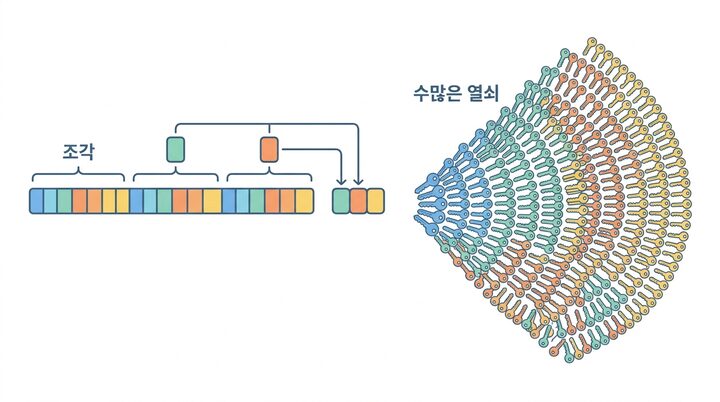
What appears in the paper is a tidy count table. What the sequencer hands you is 25 million fragments of 76 letters each. This course connects the two by hand — open real FASTQ from the SRA, measure its quality, catch the ribosomal RNA that snuck in, build a k-mer index yourself to attach reads to genes, and then check your table against the one the paper deposited in GEO.
- Part 1 The four lines of FASTQ · read names and flow-cell coordinates · Phred scores · per-position quality curves
- Part 2 37% duplicates · 20% ribosomal RNA · adapters and polyA · is trimming really necessary
- Part 3 The k-mer index · reverse complements · assigning 44,000 reads · when gene names don't match
- Part 4 Building the count table · depth and accuracy · length bias · computing the ceiling · the reproducibility verdict
 25
25
⚔️ T Cells, First Steps
One T cell recognises exactly one thing, yet your body must hold receptors for pathogens it has never met. These lessons work that design problem through in three stages — making, selecting, reading.
Not just in words: you open four real human repertoires, 11,791 cells published by 10x Genomics and compute it all yourself — including working out, from the data alone, that two of the samples are the same person.
- Part 1 V(D)J recombination · the IMGT germline set · V usage bias · CDR3 · junctional diversity
- Part 2 The two thymic thresholds · MHC restriction · survivorship bias
- Part 3 Shannon · evenness · Gini · D50 · rarefaction · clone size distributions · public clones · antigen specificity
- Part 4 CD4 subsets · regulatory T cells · cytotoxicity · memory · exhaustion · scoring the paper's Fig 8
 26
26
🎫 Antigen Presentation, First Steps
To spot an infected cell the immune system must look inside it — but the membrane is opaque. The answer was a noticeboard: a cell chops up its own proteins and hangs the fragments on its surface.
Not just in words: from 30,000 IMGT/HLA alleles and IEDB mass-spectrometry peptides you draw the polymorphism map yourself, find the binding motifs, build a predictor by hand and score it on a different experiment.
- Part 1 The MHC-I groove · the proteasome · TAP and the loading complex · MHC-II · cross-presentation
- Part 2 The HLA polymorphism map · binding motifs · anchors · a PSSM predictor · ROC and AUC
- Part 3 Neoantigens · scoring KRAS 9mers · binding ≠ presentation ≠ immunogenicity · immunopeptidomics
- Part 4 B2M and HLA loss · 10,000 TCGA samples · population frequencies · HLA-disease associations · the paper's 49-gene filter
 27
27
🚦 Checkpoints and Immunotherapy, First Steps
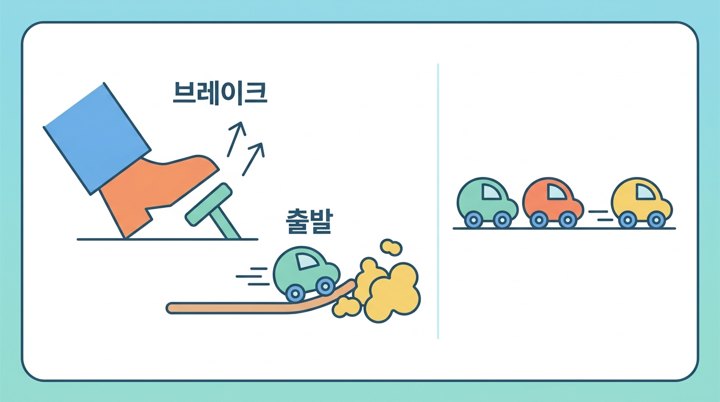
For a century the goal was to boost immunity, and it kept failing. The answer was the other way round — take your foot off the brake. That idea won a Nobel Prize, yet in most cancers only a minority respond.
These 20 lessons follow why. Not just in words: you draw the checkpoint correlation network across 10,071 TCGA tumours and score four predictive markers against lymphocyte infiltration measured from H&E slides.
- Part 1 CTLA-4 and PD-1 · the two routes that switch PD-L1 on · 10,071 pan-cancer samples
- Part 2 Where the antibody binds · IgG isotypes · LAG-3 and TIGIT · the correlation network
- Part 3 The PD-L1 assay standardisation problem · TMB and GEP · scoring with a different ruler
- Part 4 Primary, adaptive and acquired resistance · combinations · synergy and the p-value ceiling · irAEs · CAR-T
 28
28
Cell Therapy, First Steps
/tcell covered the receptor, /antigen the presentation, /checkpoint the release of the brake. These twenty lessons are the next square — engineering the cell itself into a drug. We take a CAR apart into four pieces, count the weeks it takes to make one, read ELIANA's 75 patients with confidence intervals and the rule of three attached, and see exactly where the regulatory path of /trial and /reg bends.
- Part 1 Why a cell · the four pieces of a CAR · manufacturing · lymphodepletion · persistence
- Part 2 ELIANA's 75 patients · cytokine release syndrome · neurotoxicity · two roads to relapse · three gates of solid tumours
- Part 3 TCR-T · TIL therapy · allogeneic cells · CAR-NK and CAR-macrophages · logic gates and safety switches
- Part 4 Quality control for a living drug · regulation · cost and access · putting it together · what is and is not there yet
 29
29
🌳 NK and Dendritic Cells, First Steps
Immunology usually starts with T cells — but it takes days for one to reach a tumour, and much is decided before then.
The NK cell rule is the opposite of a T cell's: it kills not because something looks wrong but because the normal signal is missing. Dendritic cells pick up antigen and walk to the lymph node to wake the T cells.
You verify the labels on 11,128 mouse immune cells, recover the rare cell type the mean had erased, and count whether dendritic cells really sit next to NK cells.
- Part 1 Missing-self · the activating/inhibitory balance · NKG2D · KIR and HLA · NK licensing
- Part 2 ADCC · cytolytic activity across TCGA · memory-like NK and CAR-NK
- Part 3 The four DC subsets · pattern recognition and STING · maturation · cross-presentation · the cDC1 bottleneck
- Part 4 Why DC vaccines are hard · the NK–DC feedback loop · Xenium spatial neighbour analysis
 30
30
🏹 B Cells and Antibodies, First Steps
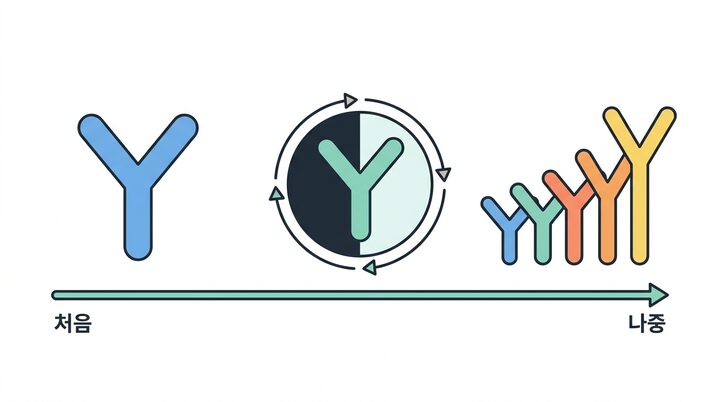
A T cell receptor is fixed once made. A B cell receptor gets better inside your body.
In the germinal centre it mutates, is tested and survives — dozens of times over a few days. Darwinian evolution turning several cycles in a single week.
You align 7,460 B cells from public 10x data against IMGT germline sequences and count the mutations yourself: IgM at 0.99%, IgG1 at 9.38%. That tenfold gap is the mark the germinal centre left.
- Part 1 Fab and Fc · the κ:λ ratio matching across three people · 95.1% allelic exclusion
- Part 2 24.2 million V(D)J combinations · CDR3 · the germinal centre · the two jobs of AID
- Part 3 Counting somatic hypermutation yourself · class switching · shortened CDR3 · Fc receptors
- Part 4 Zero shared clones across all six pairs · identifying doublets · IgG1 vs IgG4 · B cells inside tumours
 31
31
🔋 Tumour Immunometabolism, First Steps
Immunology was long a science of signals. But a signal changes nothing if the fuel is gone.
That is the layer the paper's mechanism sits in — DDX54 → NF-κB → CD38 → NAD⁺ depletion → adenosine → T cell suppression. CD38 is not a checkpoint molecule but an enzyme.
Twenty lessons follow that chain across 37,585 cells — and, while measuring the metabolism of exhausted T cells, discover that the 'exhaustion score' was an activation score all along.
- Part 1 A signal without fuel · what resting and fighting T cells burn · a transcriptome is capacity, not metabolism
- Part 2 Glucose competition · lactate as a signal · hypoxia and HIF-1α · arginine and tryptophan · why the IDO phase 3 failed
- Part 3 The NAD⁺ balance · CD38 — topped by B cells here · CD39-CD73 · A2A · the adenosine axis falling 0.892 → 0.580
- Part 4 The metabolic face of exhaustion — the textbook prediction fails · lipids · M1/M2 metabolism · in human data only half of it holds
 32
32
🚚 Immune Trafficking, First Steps
Most immunology is about recognition. But there is a problem before that — the cell has to get there.
The paper writes: anti-PD1 alone recruits lymphocytes but does not drive them into the tumour core.
These twenty lessons teach that grammar and then score that claim against coordinates. Measure 'infiltration' five ways across 100,000 cells and the five disagree.
- Part 1 Chemokines and chemotaxis · the four steps of adhesion · selectins, integrins, ICAMs · the chemokine checkpoint as bottleneck
- Part 2 The lymph node as architecture · HEVs · imprinting — where you woke decides where you go · tissue residency
- Part 3 Tumour vessels leak yet cells cannot exit · the stromal barrier · four ways to silence a chemokine · the feedback loop
- Part 4 Five metrics, five answers · distance profiles · neighbourhood composition · TLS · two of the paper's three claims supported, one left undecided
 33
33
🕳️ Cancer Immune Evasion, First Steps
More mutations means more for the immune system to see. Yet the tumours in this paper have plenty of mutations, intact antigen presentation — and no T cells.
These twenty lessons are the catalogue of how: not being seen, not being caught, not letting anyone in.
And not just the catalogue — you score each one across 407 TCGA lung adenocarcinomas and check which of the paper's five claims survive in three cohorts.
- Part 1 Immunosurveillance and the three E's · elimination, equilibrium, escape · the catalogue in four groups
- Part 2 MHC-I loss and B2M · JAK1/2 acquired resistance · scoring the recognition circuit — and watching it vanish (p = 0.94) once infiltration is removed
- Part 3 PD-L1, CD47, CD24, CD38 · splitting induced from constitutive by IFN-γ correlation · the paper's two targets land in opposite groups
- Part 4 Wnt-driven T cell exclusion · Myc and immunity · EMT (comes out reversed) · fetal mimicry · master regulators · validation in three cohorts
 34
34
🍖 Macrophages and Myeloid Cells, First Steps
Cancer immunotherapy is almost always told through T cells. Yet dissociate a tumour and count: T cells are only 4.3%. What fills the space is the myeloid compartment — 85.1%.
A T cell has picked a side. A myeloid cell has not. The same macrophage can eat a cancer cell or lay the vessels that feed it.
Twenty lessons rebuilding the paper's Fig. 7 from its own markers, then testing with independent genes whether those labels earn their names.
- Part 1 Census of a tumour (85.1% myeloid) · yolk-sac vs bone-marrow origin · two kinds of monocyte · why alveolar macrophages are absent here
- Part 2 Phagocytosis and opsonins · the CD47-SIRPα 'don't eat me' signal · why this dataset cannot test the paper's Cd47 claim · efferocytosis
- Part 3 M1/M2 is not one axis (r = −0.179; 21.9% high on both) · TAMs · MDSCs · neutrophils and NETs — and why transcriptomes cannot see NETs
- Part 4 Fig. 7 reproduced (M1-like 11.46→28.07%, circulating 27.34→13.75%) · independent label validation · confirming it in spatial data
 35
35
📡 Cytokines and Signalling, First Steps
Every immunology course repeats the same sentence — IFN-γ matures the DC, IL-12 pushes Th1, TGF-β switches to IgA. All pointing at the same thing, and none of them saying what it is.
These twenty lessons are that gap — starting with the fact that it is not easy: across ten thousand tumours the cytokine axes do not separate at all.
Lessons 11 to 13 work out why, and what kind of data you have to bring in before the question can be answered.
- Part 1 Concentration and range · who makes what (0.08% of cells make Il12b) · pleiotropy and redundancy
- Part 2 Shared receptor chains · JAK-STAT · does the chain really hold · SOCS feedback
- Part 3 The axes fail to separate · infiltration as a confounder · the hard limit of bulk · asking again with single cells
- Part 4 Cytokine storm · the narrow window of IL-2 · why blocking worked · drawing the cytokine map
 36
36
🦠 Immunology, First Steps
What makes a paper hard is usually the vocabulary, not the mathematics. Antigen presentation, TMB, immune deserts, checkpoints, exhausted T cells, M1 monocytes, regulatory T cells — every term in the DDX54 paper, unpacked one at a time, until you can read the abstract and all eight figures yourself.
It is a concepts course, but every number is real: 4,702 TCGA patients and values the sibling courses on this site computed from raw data.
- Part 1 Self and non-self · innate and adaptive · antigen presentation and MHC · the TCR and clonal expansion · neoantigens and TMB
- Part 2 The tumour microenvironment · inflamed, excluded and desert tumours · checkpoints · CD47 and CD38 · M1/M2 myeloid cells
- Part 3 Naive → effector → memory · T cell exhaustion and epigenetic scarring · regulatory T cells · NK, B and dendritic cells
- Part 4 Checkpoint inhibitors · predicting response and the AUC · the fetal disguise · what each assay trades away · how to read a paper
 37
37
🛡️ The Single-Cell Immune Map, First Steps
In a tumour given immunotherapy, the lymphocyte fraction jumped from 2% to 21%. The number is large, the direction is consistent, and it happens in only one of four arms. How far should you believe this result?
You answer that with 37,585 immune cells from the raw data (GSE268555) — that compositions are locked together, that testing on cells drives p down all by itself, and that with four samples the smallest p you can possibly produce is 0.25.
- Part 1 Reading the cell-type map · who assigned these names · the tumour cells caught in the map
- Part 2 A 2×2 design with one sample per cell · comparing compositions · the closure problem · the chi-square trap
- Part 3 Pseudoreplication and the permutation wall · effect size · the illusion a signature creates
- Part 4 Pseudobulk · ligand–receptor · checking the claims one line at a time · how it should have been designed
 38
38
🔬 Tumour-Infiltrating Lymphocytes, First Steps
A tumour slide is cut into 50 µm patches, and for each patch a CNN answers "is there a lymphocyte here?" 5,202 TIL maps built that way are public.
This course counts those pixels by hand — starting from what to use as the denominator and where to draw the threshold, and arriving at the facts that two slides from the same patient flip the verdict 22.8% of the time, and that mixing cancer types flips the sign of the conclusion.
- Part 1 Reading the map · choosing a denominator · drawing the threshold · what the patch size decides
- Part 2 The distribution across 5,202 slides · skew · checking confounders · spread and depth · naming things
- Part 3 Reproducibility · clinical variables · Kaplan–Meier · the log-rank test
- Part 4 Cutoff hacking · multiple testing · Simpson's paradox · batch effects · permutation tests
 39
39
🧬 The Cancer-Cell Digital Twin, First Steps
Treat each gene as one switch and a cell becomes a short string of 0s and 1s. Roll that string forward by the rules and out comes the cell's fate.
You build an eight-gene cancer-cell digital twin by hand and test every possible genetic intervention against all 256 cell states to find the target that erases the cancer attractor — rebuilding, at the smallest possible scale, the skeleton of the method (MObyDiCK) by which Prof. Kwang-Hyun Cho's KAIST team found DDX54.
- Part 1 Switches and state vectors · AND, OR, NOT · synchronous update · attractors · basins
- Part 2 Naming phenotypes · the eight-gene twin · feedback loops · two valleys · asynchronous update
- Part 3 Perturbation · knocking out DDX54 · exhaustive screening · reversion efficiency · dormancy
- Part 4 Three pitfalls · combinatorial explosion · robustness of the rules · wet-lab validation · the real MObyDiCK
 40
40
🧪 Laboratory Chemistry, First Steps
The methods section of a paper is a chemical prescription. “20 mM HEPES (pH 7.2), 150 mM NaCl, 0.5% Triton X-100, 10% glycerol, 0.1% SDS” — six decisions in two sentences. These 20 lessons teach you to read them.
- Part 1 Molarity and units · buffers and temperature · PBS and osmosis · the CO₂ buffer system
- Part 2 CMC and micelles · lysis buffers · SDS-PAGE · HRP chemiluminescence · lipofection · puromycin
- Part 3 Chaotropes and silica · Beer-Lambert · SYBR Green · fixation · H&E · compensation · DAPI · Xenium
 41
41
🐁 In Vivo Experiments, First Steps
Confirm a computationally chosen gene in a living body. Inject lung cancer cells under the skin of a C57BL/6N mouse, give anti-PD1 every two days, measure the tumour with calipers, and draw a Kaplan-Meier curve.
It starts from why four groups and not two, and goes through where L×W²/2 comes from, how n=7 gets decided, and what actually goes into an IACUC protocol.
- Part 1 What a dish cannot answer · syngeneic models · four cancer models · IACUC and the 3Rs · the animal facility
- Part 2 Shaving and scheduling · how many cells to inject · 200 µg anti-PD1 · the isotype control · the 2×2 design
- Part 3 Randomisation · calipers and tumour volume · growth curves · resected weight · growth ratios
- Part 4 Kaplan-Meier · the log-rank test · ANOVA and Bonferroni · power and n · bridging to a patient cohort
 42
42
🩸 Humanized Mice, First Steps
Anti-PD1 binds human PD-1 only — not the mouse receptor. To test that drug you have to build a human immune system inside the mouse.
The three genes that erase mouse immunity, the Sirpα that keeps human cells alive, the conditioning dose and the CD34⁺ injection, the %hCD45 twelve weeks later, and the clock that xenogeneic GvHD starts.
- Part 1 A key that does not fit · scid, Rag and the gamma chain · Sirpα and CD47 · NSG, NOG, NRG, BRG
- Part 2 hu-PBL, hu-CD34, BLT · cord blood versus mobilised blood · the conditioning trade-off · intrahepatic and tail-vein injection
- Part 3 %hCD45 · B first, T later · cytokines that do not cross species · MISTRG and NSG-SGM3 · whose HLA
- Part 4 Xeno-GvHD · CDX and PDX · anti-PD1 at 10 mg/kg · the flow panel · donors as blocks · the one-page protocol
 43
43
💊 Pharmacokinetics, First Steps
A drug does not work by dose — it works by the concentration where the target is. The same 100 mg vanishes in half an hour for one drug and lingers for three days for another.
You compute by hand the four constants behind that difference — clearance, volume of distribution, half-life and AUC — and end by deriving a first-in-human dose from one set of mouse data.
- Part 1 Dose versus concentration · ADME · first-order elimination · volume of distribution · clearance · AUC by trapezoids
- Part 2 Oral absorption and Tmax · bioavailability and first pass · CYP induction and inhibition · protein binding · two compartments
- Part 3 Steady state and loading dose · interval and trough · saturable elimination · the kidney and dose adjustment
- Part 4 Allometric scaling and HED · Emax and hysteresis · TMDD of antibodies · a full NCA · the first-in-human dose
 44
44
⚠️ Toxicology and GLP, First Steps
An efficacy study looks at one point — does it work here. A toxicity study looks at the whole curve — where does harm begin.
You design the dose groups, justify how high the top dose goes, read the clinical chemistry and the histopathology, and set a NOAEL by hand — then meet the GLP that makes every record of it believable.
- Part 1 The dose makes the poison · threshold and slope · the retirement of the LD50 · the six pillars of GLP · raw data
- Part 2 The ICH M3(R2) package · duration matching · choosing species · dose groups and the top-dose rationale · recovery and satellite groups
- Part 3 Single and repeated dose · body weight and food intake · ALT and BUN · necropsy and grading · the adverse call
- Part 4 Toxicokinetics and safety margins · the genotoxicity battery · safety pharmacology and QT · reproductive and carcinogenicity studies · a full 13-week case
 45
45
🩺 Clinical Trials, First Steps
It worked in mice. So how much do you give a person, to how many people, measuring what?
From the 100 µg of phase 0 to the 3:1 randomisation, double blinding and escalation rules of phase I, you take the blueprint apart piece by piece, and end by drawing the line between what you may and may not say. The material is the phase I trial of a TNIK inhibitor published in Nature Biotechnology in 2024.
- Part 1 Phases and paperwork · deriving the first dose · the 100 µg phase 0 microdose
- Part 2 Single and multiple ascending doses · 3:1 randomisation · double blinding · sentinel dosing
- Part 3 Primary and secondary endpoints · AE grading and seriousness · food effect · phase I PK
- Part 4 Helsinki and GCP · trial registries · healthy volunteers · statistics of small samples · what you may say
 46
46
🏛️ Phase II, Phase III and Approval, First Steps
Phase I only says it can be tolerated. Everything after that is these twenty lessons — choosing a dose in phase II, calculating how many people phase III needs, fixing the primary endpoint in advance, and finally standing in front of a regulator with the dossier.
The material is the two drugs for pulmonary fibrosis that were approved on the same day, 15 October 2014. One had twin phase III trials that both succeeded; the other had one that succeeded and one that did not, was refused, and had to run a third.
- Part 1 After phase I · dose-finding · surrogate endpoints · the minimal important difference
- Part 2 Power and sample size · stratification and concealment · choosing a control · non-inferiority margins
- Part 3 ITT and missing data · interim analysis and the DSMB · twin trials · multiplicity · subgroups
- Part 4 Benefit and harm · the five CTD modules · review and complete response · the label · what you may say
 47
47
🚰 Epidemiology and Observational Studies, First Steps
/reg said randomisation balances even what you did not measure; /stat said adjustment removes only what you did. These twenty lessons are the question that follows — what do you do when you cannot assign?
You cannot assign someone to smoke. Yet Snow stopped a cholera outbreak without knowing its cause, and smoking and lung cancer were settled without a trial. How that was possible, and exactly where observation misleads — confounding, selection, information, immortal time and collider bias, turned by hand.
- Part 1 When you cannot assign · Snow 1854 · incidence and prevalence · cohorts · case-control
- Part 2 Cross-sectional and ecological fallacy · risk ratio and odds ratio · not how many times but how many people
- Part 3 The five biases — confounding, selection, information, immortal time, collider
- Part 4 Propensity scores · the E-value · Hill's nine viewpoints · three illusions of screening · when trials disagree
 48
48
💠 Flow Cytometry and Histology, First Steps
Look at the same tumour twice — grind it up and count, fix it and see.
Strain through 70 µm, block Fc, design a fluorescence panel, draw gates and count CD8 T cells. Then fix that same tumour as FFPE, cut it at 5 µm, stain it with H&E, and count TILs across the whole slide.
It ends where the paper ended — the same 3.5% is not the same 3.5%.
- Part 1 Counting versus seeing · dissociation at 70 µm · dead cells and doublets · the Fc block
- Part 2 Fluorescence basics · panel design · compensation and FMO · scatter · the six gating steps
- Part 3 Comparing four groups · FlowJo and reproducible gates · CD45⁺ sorting · sorting stress
- Part 4 FFPE · 5 µm sections · H&E · ten seconds of differentiation · whole-slide scanning · TIL quantification
 49
49
🧫 Cell Culture, First Steps
Trace any figure in the paper back far enough and you reach one petri dish. Start at the laminar flow hood, change medium, passage, count cells, and record growth curves on an IncuCyte.
Not the hands that grow cells but the decisions made while growing them — what is in DMEM, why passage number matters, and how an invisible mycoplasma can overturn a result.
- Part 1 Why cells first · aseptic technique and 70% ethanol · DMEM, FBS, antibiotics · 5% CO₂ and pH
- Part 2 What each of the four cell lines does · passaging and trypsin · the hemocytometer · freezing and thawing
- Part 3 Designing a 96-well plate · IncuCyte confluence · the three phases of a growth curve · doubling time
- Part 4 Mycoplasma · cross-contamination and STR · handling a contamination · the lab notebook · two meanings of replicate
 50
50
✂️ Genetic Perturbation, First Steps
The paper used siRNA, shRNA and CRISPR on the single gene Ddx54. Why go to that trouble? Because the three methods fail in different ways.
From where RISC cuts an mRNA, through the four lentiviral plasmids, to the point where a cell repairs Cas9's cut badly and breaks the gene — followed with the actual sequences from Tables S1–S3.
- Part 1 Three levels of switching off · RNA interference and RISC · the sequences in Table S1 · the scramble control · lipofection
- Part 2 The knockdown time window · reading knockdown efficiency · the shRNA hairpin · four lentiviral plasmids
- Part 3 Making virus in 293T · polybrene and MOI · the puromycin kill curve · pools versus clones
- Part 4 CRISPR and frameshifts · why guides are 20 nt · off-targets · knockdown versus knockout · validation
 51
51
🧷 Molecular Assays, First Steps
“We knocked it down” is a claim. It becomes proof only when measured.
Follow both routes side by side — extract RNA, make cDNA, count with SYBR Green; extract protein and catch it with an antibody. Work out ΔΔCt by hand, read the fourteen antibodies of Table S4 pathway by pathway, and find in Fig. S9 what the cropped figure hid.
- Part 1 Two routes to proof · RNase and the silica column · NanoDrop's two ratios · cDNA synthesis
- Part 2 The primers of Table S5 · spanning an exon junction · SYBR Green · Ct and melt curves
- Part 3 Reference genes · ΔΔCt by hand · standard curves and efficiency · the six parts of a lysis buffer · phosphatase inhibitors
- Part 4 SDS-PAGE · transfer and blocking · the fourteen antibodies of Table S4 · loading controls · saturation · full blots
 52
52
📦 Sequencing Libraries, First Steps
All four dry-lab courses begin with one FASTQ file — and none of them says where it came from.
These 20 lessons fill that gap: follow the hands that build all four libraries (QuantSeq 3′, small RNA, 10x 5′ single-cell, Xenium in situ), and end at the point that matters — the choices made here become constraints no analysis can undo.
- Part 1 Where a FASTQ comes from · the anatomy of a library · RIN and DV200 · comparing the four methods
- Part 2 Adapter ligation · indices and Hamming distance · bridge amplification · SBS and phasing · read length
- Part 3 Dissecting the four lines of FASTQ · how QuantSeq 3′ removes length bias · PAGE size selection
- Part 4 10x GEMs and UMIs · computing the doublet rate · Xenium probes and ligation · normalising transcript counts · the handoff
 53
53
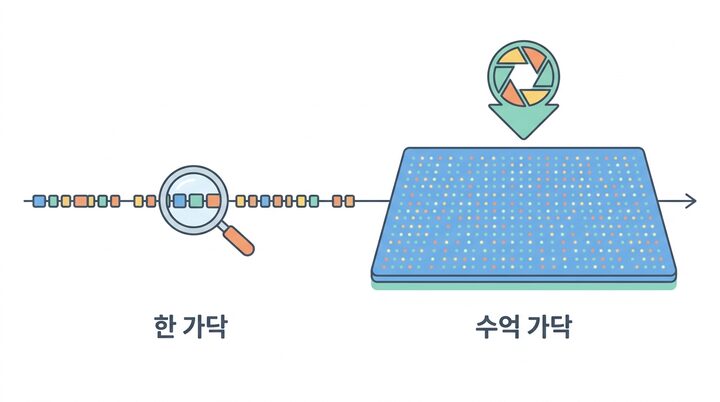
🔆 Illumina Sequencers, First Steps
What the machine that plants 400 million strands on one glass slide and photographs them one letter at a time actually does, and what you have to hand it — from SBS chemistry down to cartridges and single-use consumables.
Then six bulk RNA-seq samples are carried from RNA extraction to a volcano plot.
- Part 1 Why read short and often · choosing an instrument · the SBS cycle · four-colour versus two · Q scores
- Part 2 Flow cells and %PF · six hours of thawing · single-use consumables and cost per sample
- Part 3 RNA extraction · NanoDrop, Qubit and RIN · poly(A) or rRNA depletion · index hopping
- Part 4 BCL is written column-wise · the four lines of FASTQ · trimming · STAR versus Salmon · batch effects · CPM, TPM and FPKM · DESeq2 · the full walk-through
 54
54
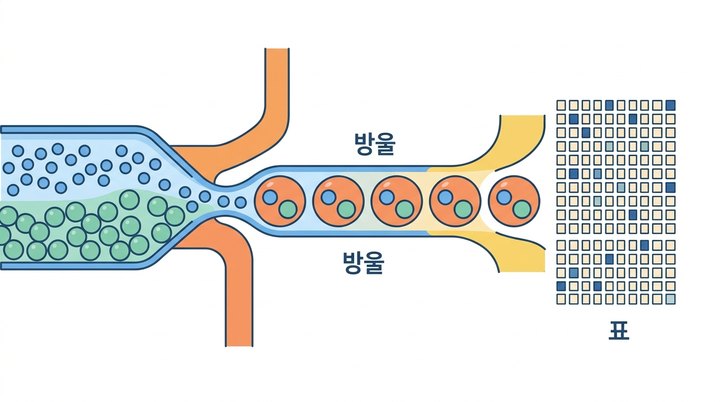
💧 10x Genomics, First Steps
What the machine that traps one cell per oil droplet actually does, and what bytes the file it produces is made of — taken apart by hand.
At the end you carry one public 10x PBMC sample from the instrument all the way to cell types.
- Part 1 What an average hides · Chromium and the chip · gel beads and GEMs · 6.8 million cell barcodes · UMIs
- Part 2 3′ versus 5′ · a day at the bench · cells loaded versus the doublet rate · R1 is the label, R2 is the content
- Part 3 The six steps of Cell Ranger · the three files of matrix.mtx · HDF5 and CSC · the eleven numbers of a web_summary
- Part 4 The knee plot and EmptyDrops · three QC thresholds · ambient RNA and doublets · normalisation · PCA and clustering · the full PBMC walk-through
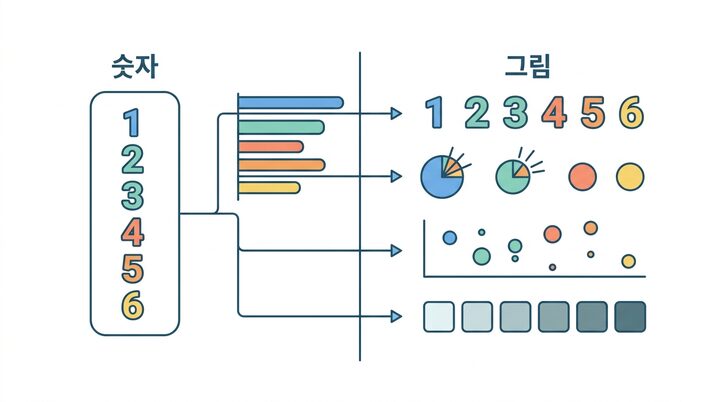 55
55
📊 Data Visualization, First Steps
One paper's figures: eight of them, 62 panels, nineteen kinds of chart — from plain bars to UMAP, nearly everything in use today.
You redraw all nineteen from the real data, learning what each one hides and which ones mislead.
- Part 1 All 62 panels counted · visual channels and the accuracy ranking · kinds of data · points, lines and bars · axes · colour
- Part 2 Bars · four ways to show a distribution · volcano plots · heatmaps · error bars · survival curves
- Part 3 UMAP and density · dot plots · small multiples · pie charts · network graphs
- Part 4 Truncated axes · dual y-axes · cherry-picking · from raw counts to a finished figure · the pre-flight checklist
 56
56
🧮 TCGA, First Steps
Downloading TCGA takes five minutes. What comes after is the hard part — what exactly did this cell count? You open, one cell at a time, the clinical table of 12,591 samples, 11,081 patients and 33 cancer types, plus mutations, TMB, copy number and expression for 566 lung adenocarcinomas.
- Part 1 Twenty-eight characters of barcode · sample types · one patient, many rows · four portals · counts vs TPM · log2(x+1)
- Part 2 Three kinds of blank · four survival endpoints · one MAF row · the missing TMB denominator · filters · the five GISTIC bins
- Part 3 Source sites and batch effects · aneuploidy, FGA, MSI · mutual exclusivity and subtypes · Kaplan–Meier · cut-off hunting · what you may claim
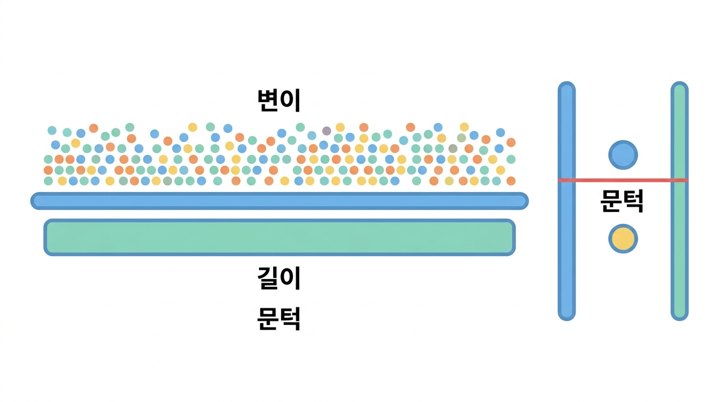 57
57
➗ Tumour Mutational Burden, First Steps
A single number — mutations counted, then divided — decides whether a patient gets a checkpoint inhibitor. Yet what to count, and what to divide by, is written down nowhere. You build that number from 130,000 mutations across 566 lung adenocarcinomas, then test it against the survival of 1,661 patients actually treated with immunotherapy.
- Part 1 One MAF row · recovering the 30 Mb denominator · variant classes · silent mutations · VAF and depth · TMB by hand
- Part 2 Distributions and log scales · the threshold of 10 · gene panels · recovering panel denominators · same patient, different assay
- Part 3 A ladder of 33 cancer types · MSI · source-site effects · 1,661 treated patients · Kaplan–Meier · cut-off sweeps · immune deserts
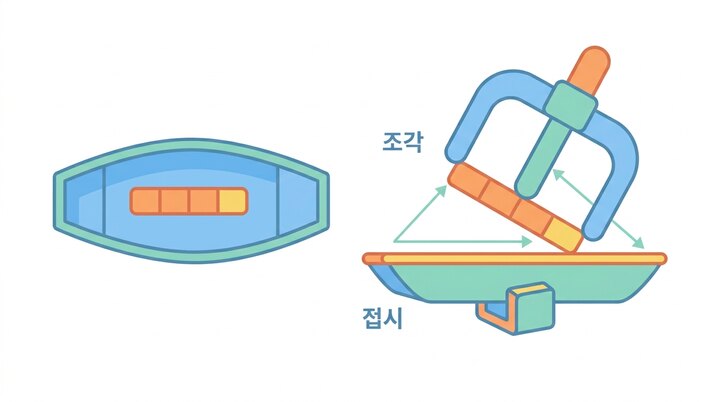 58
58
🤝 TCR-HLA and CD4/CD8, First Steps
An antibody sees one thing. A T cell receptor always sees two — a fragment, and the plate holding it. Counting 181,411 VDJdb rows and 24,518 HLA alleles yourself, you find that what differs between people sits in the groove alone, while the loop CD4 and CD8 hold on to barely moves.
- Part 1 The pMHC pair · closed and open grooves · docking polarity · germline or selection · what a coreceptor grabs
- Part 2 Opening 181,411 rows · 57% restriction · per-position entropy · the seven-residue loop · the shape of both lineages
- Part 3 Ten thousand times weaker · dwell time and kinetic proofreading · delivering Lck · how the thymus picks a side
- Part 4 Alloreactivity · cross-reactivity · HLA-E and non-classical plates · class I falling on one B2M · who can see it
 59
59
Perturb-seq First Steps
Silence one gene, read twenty thousand answers — genome-scale CRISPRi × scRNA-seq screen on primary human CD4+ T cells
- Part 1 Why Perturb-seq · CRISPR that cuts versus CRISPRi that silences · CD4+ T cells · rest, 8 h and 48 h · reading one cell's recipe
- Part 2 11,526 genes in one pot · counting what changed · pseudobulk and DESeq2 · did it really switch off · do two guides agree
- Part 3 The strongest perturbations — TADA2B to CTLA4 · genes that break alike belong together · exploring 112 clusters
- Part 4 Three traps · change the condition and the answer changes · too few cells and the conclusion wobbles · off-target, silencing the neighbour
- Part 5 Putting a camera on a GWAS address · good targets and bad · redrawing Figures 3 and 4 from scratch · what can and cannot be said
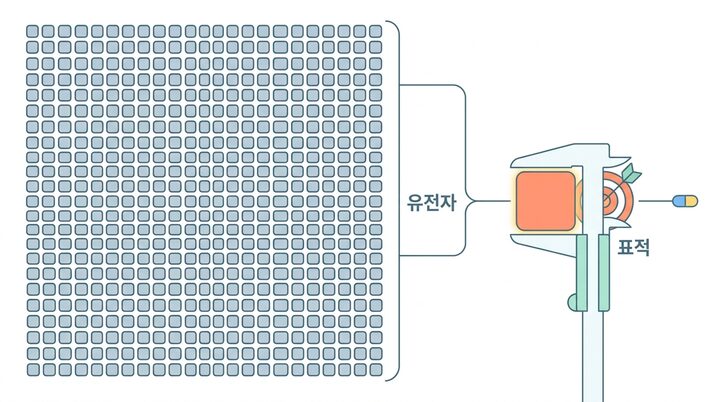 60
60
🎯 Insilico Medicine, First Steps
Before there can be a drug, someone picks one gene. That picking is target discovery. Taking the 14 programmes one company publishes, these lessons start from what a gene even is and unpack what question each name — TNIK, WRN, MAT2A, KIF18A — was an answer to. Synthetic lethality, pathway addiction, immune evasion: six boxes, and all fourteen sorted into them.
- Part 1 What a target is · genes and proteins · the pocket a drug binds · six discovery logics
- Part 2 TNIK, named by the data · 3CLPro, an enzyme we do not have · PHD, a switch the body already runs
- Part 3 Five synthetic-lethal programmes · USP1 · WRN · MAT2A · CDK12 · KIF18A
- Part 4 KAT6 · TEAD · FGFR2/3 pathway addiction · QPCTL · ENPP1 · DGKA, three immune bets
- Part 5 Five ways a target collapses · scoring all fourteen yourself · what can and cannot be said
 61
61
Finding WRN, First Steps
In 2019 four teams arrived independently at the same gene: WRN. Nobody guessed the name; it was simply at the top once the table was sorted. That table is loaded here — 608 cell lines by 17,097 genes from DepMap. Over 20 lessons you sort it again by hand. Rank by t and WRN is 7th; add the conditions a target must meet and it is 1st.
- Part 1 One gene off · synthetic lethality · MSI · CRISPR screens · gene effect scores
- Part 2 The dependency map · splitting the table · Welch's t · ranking · volcano plots
- Part 3 Multiple testing and FDR · common essentials · lineage confounding · stratification · the nine blood lines
- Part 4 Expanded TA repeats · which domain to inhibit · thresholds · reproducing 2019 · summary
 62
62
Perturb-seq for Drug Discovery, First Steps
The most expensive mistake in drug discovery is not picking the wrong target — it is testing the right target in the wrong cell. You make that mistake on purpose against a live Perturb-seq API with 15 real pipeline targets, then move to the targets this data can answer. You build the Python client by hand and simulate perturbations with widgets.
- Part 1 The right target, no effect · Perturb-seq · CRISPRi · the screen
- Part 2 First request · building the client · putting 15 pipeline targets in
- Part 3 Reading a zero · cell as context · state flips the answer · knockdown and cell count
- Part 4 Clusters · disease links · comparing targets · the simulator · five traps · full run
 63
63
Target Discovery, First Steps
You switched off ten thousand genes. Which one is the target? The gene that moved the cell most is usually toxicity, not a target — it is the gene every cell needs. From building a disease signature through reversal scoring, cell-cycle correction, the DepMap safety filter, tissue restriction, druggability and human genetics, you build four layers of filters and push 135 real CRISPRi screen results through them: 135 to 54.
- Part 1 Why targets · correlation is not causation · disease signature · cell model · modality
- Part 2 Library design · power · knockdown QC · energy distance · reversal scoring
- Part 3 The cell-cycle false hit · functional clusters · master regulators · DepMap · tissue breadth
- Part 4 Druggability · human genetics · five traps · ranking targets · the validation ladder
 64
64
GEO, First Steps
8.7 million expression samples are already sitting in a public archive. Can you find a drug target in them? We download four real datasets on a lung-scarring disease, put them on one ruler, combine them and rank the genes — then find where the method starts lying.
- Part 1 Why other people's data · accessions · platforms · series matrix · who is a patient
- Part 2 Scales · probes to genes · differential expression · effect size · combining · I²
- Part 3 Random effects · FDR · sign consistency · batch effects · what 'normal' was · publication bias
- Part 4 Expression is not a target · why we missed TNIK · putting it together · what you may claim
 65
65
SRA, First Steps
A public dataset's numbers already carry the depositor's processing decisions, and you cannot take them out. What came before is in SRA. We pull the real metadata for 713 runs: eight library selections inside RNA-Seq alone, a 4,828-fold depth spread, and a Disease field that is 100% empty.
- Part 1 Someone else's decisions · accessions · 47 columns of runinfo · library strategy
- Part 2 PolyA vs ribo-depletion · layout and length · 4,828-fold depth · four lines of FASTQ
- Part 3 The empty Disease field · crossing to the labels · the pipeline · normalisation
- Part 4 What reprocessing cannot fix · 4.4 terabytes · reprocessed resources · when to go down
 66
66
Answer ALS, First Steps
There is no drug that stops ALS, because nobody knows where to aim one. To find that place, one company stacked two layers of data — spinal cords from the dead, and motor neurons grown from the blood of the living. Five public datasets show why one layer was never enough.
- Part 1 A disease with no target · motor neurons · why knowing SOD1 is not enough · post-mortem tissue
- Part 2 Rows that swap places · delays that will not parse · the same patient twice · tissue mismatch
- Part 3 The combined result · an all-immune top list · cell composition · GFAP at I²=92.5% · r=0.43
- Part 4 iPSC motor neurons · four omics layers · stacking two layers · one of the verified eight
 67
67
GWAS Catalog, First Steps
Targets with human genetic support are said to be twice as likely to be approved. These lessons work out what that support is, from 1.19 million GWAS Catalog associations and TCGA somatic mutations — a median odds ratio of 1.14, and the illusion that makes TTN look more mutated than KRAS.
- Part 1 What genetic evidence buys · how GWAS works · 1.19M associations · where 5×10⁻⁸ came from
- Part 2 Median OR 1.14 · linkage disequilibrium · the MAPPED_GENE trap · MUC5B · C9orf72 · ancestry
- Part 3 Somatic mutations · the TTN illusion · dividing by length · hotspots · reading direction
- Part 4 Scoring evidence · what absence means · what our two diseases actually have · synthesis
 68
68
Retracing the TNIK Discovery
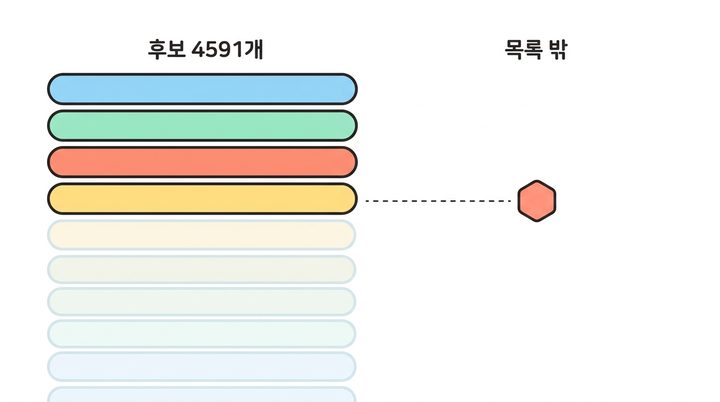
Idiopathic pulmonary fibrosis had 4,591 candidate targets. TNIK — the one that became a drug — is not even in the top 300. PubMed counts zero IPF papers for it at the time of discovery, and a patient-tissue expression meta-analysis misses it too. Yet that gene became a drug that reached phase 2a. You rebuild the ranking in Python against three live APIs (Open Targets, PubMed, Perturb-seq), find the one dial that puts TNIK first, then go to check causality and meet the wrong cell.
- Part 1 A lung that stiffens · the two existing drugs · what one target decides · seven kinds of evidence · Open Targets
- Part 2 A contaminated ranking · TNIK is not on the list · counting novelty on PubMed · one dial · the blind spot of expression
- Part 3 The Perturb-seq API · perturbing every candidate · Wnt and SMAD1 · eight druggability boxes · knocked down, nothing happened
- Part 4 Three kinds of silence · what the data can answer · 18 months and 78 people · 71 patients in phase 2a · what can and cannot be said
 69
69
Somatic Mutation Databases, First Steps
Look one variant up in five places and five answers come back — different coordinates, different names, different calls. Yet most of the work is joining: attaching COSMIC recurrence, ClinVar calls and gnomAD frequencies to your own table. When that join slips it raises no error — conclusions appear that were never there and real ones vanish. Within a real 982-row MAF, 17 protein names already point at more than one genomic coordinate. You count it all by hand, from join keys, HGVS, builds and left-alignment through hotspots, length correction and driver calling.
- Part 1 Five answers · the map of databases · germline vs somatic · join keys · rs numbers
- Part 2 Three HGVS layers · hg19 vs hg38 · renamed genes and Excel · left-alignment · doing the join
- Part 3 Recurrence · the shape of a hotspot · dividing by length · drivers and passengers · on and off
- Part 4 Database bias · only what the panel saw · VAF and germline filtering · the variant card · the join checklist
 70
70
In-Silico Target Discovery Practicum
A company's public pipeline carries this line — “PHD inhibitors for inflammatory bowel disease and chronic kidney disease”. Query the data, though, and that target is not in the top 500 of the 7,629 linked to IBD, with one paper to its name. In kidney disease it ranks 14th — until you remove the single box marked “a drug already exists”, and it falls to 400th. You measure that gap yourself in Python against four live sources (Open Targets, ChEMBL, ClinicalTrials.gov, PubMed), hunt down the evidence living outside the table, and catch the one and only trial in the world testing it.
- Part 1 One line, two diseases · the body's oxygen gauge · oxygen as the substrate · six discovery logics · seven thousand targets
- Part 2 14th in kidney disease · three identical scores · drop one box, fall to 400th · absent in IBD · a single paper
- Part 3 The genetics points at blood · the gut is hypoxic by design · 3,879 ChEMBL readings · a selectivity table full of blanks · the box with zero measurements
- Part 4 Approved, and unlabelled · the drug that fell first, 236 patients · the only trial in the world · your own scoreboard · the blanks left blank
 71
71
From Inverted Papilloma to Carcinoma
Under the microscope an inverted papilloma in the nose is not cancer. Yet one to four in ten become cancer, and the microscope cannot say which. One paper took matched normal mucosa, papilloma and carcinoma from 11 patients and read the exome, the transcriptome and the mitochondrial genome of each. The three rulers disagreed: mutations carried over in 5 of 10 patients, mitochondrial variants in none at all, yet 2,692 genes climbed a staircase in RNA. You measure that disagreement yourself, then rebuild the AI-ranked target list by hand.
- Part 1 One in 100,000 · a benign lump · matched sampling · paraffin · three rulers
- Part 2 Volcano · measuring a staircase · the top 200 · GSEA · iPANDA
- Part 3 Calling rules · familiar drivers · the EGFR the filter erased · five of ten · copy number
- Part 4 Mitochondria that shared nothing · one HPV case · scoring without text · two tiers · the blanks
 72
72
Protein Structure Prediction, First Steps
To dock a molecule into a protein the PDB does not have, you must first build the shape. But a prediction server returns coordinates for any sequence you feed it — even a wrong one. So six lessons on building are followed immediately by five on measuring: helices and sheets, template search, I-TASSER, ProSA Z-scores, Verify3D, Ramachandran plots, estimated RMSD and pocket druggability — on a real paper's numbers: 67.4% most favoured, five disallowed residues, Drug Score 0.84.
- Part 1 Why build at all · four levels · helices and sheets · loop flexibility · disulfides
- Part 2 GOR4 and PROMOTIF · three routes · half a template · I-TASSER · consensus of six
- Part 3 ProSA Z-score · Verify3D 97.16% · Ramachandran 67.4% · RMSD 1.5 Å · preparation
- Part 4 CD-Search and E-values · pseudokinases · pocket finding · re-reading Table 1 · limits
 73
73
Docking and Molecular Dynamics, First Steps
One molecule chosen out of 45,000. How far should you trust it? Following ZINC, LigPrep, HTVS/SP/XP, AutoDock Vina, ADMET filters, GROMACS and MM-PBSA on one paper's real numbers, you work out for yourself why a score of −20.66 kcal/mol is not a free energy, why a tannin came first, and why 484 kcal/mol cannot be a binding energy. 45,000 → 7,779 → 300 → 50 → 10.
- Part 1 The funnel · ZINC · ligand prep · pose and score · scoring functions · what stays flexible
- Part 2 HTVS→SP→XP · two scales · 2-D interaction maps · Lipinski · ADMET
- Part 3 A tannin came first · ligand efficiency · PAINS · what MD adds · box and force field
- Part 4 Equilibration · did the RMSD plateau · RMSF and hinges · occupancy · MM-PBSA · the bar for experiment
 74
74
Personalised mRNA Cancer Vaccine, First Steps
Read one dog's tumour and blood whole and you get 200 gigabytes. Five months later that file had become 0.5 millilitres of clear liquid in a syringe. The novel Coding for Rosie tells those five months; these twenty lessons let you turn the knobs behind its numbers — move the threshold and 94.3% becomes something else, drop the depth and VAF wobbles, add PEG and size fights encapsulation. Somatic variant calling, Mutect2, VEP, RMSD, OpenMM, NetMHCpan, sequence design, IVT and RIN, SM-102, LNP, DLS, endosomal escape. 200 GB → 4,847 → 3 → 91 nm.
- Part 1 The map of the story · a ruler for sizes · alignment and coverage · somatic variant calling
- Part 2 VEP and consequence · drivers and passengers · AlphaFold and pLDDT · where you measure RMSD
- Part 3 DFG-in/out and drug resistance · surface exposure · 100 ns of OpenMM · NetMHCpan and nanobodies
- Part 4 Sequence design and MITD · codon optimisation · IVT and RIN · the pKa of SM-102 · LNP and DLS · endosomal escape · the limits of n=1
 75
75
Endosomal Escape, First Steps
A cell has swallowed a lipid nanoparticle. But what has been swallowed is not yet inside the cell — one membrane still stands in the way. Only one or two in a hundred get through it; the rest are cut up in the lysosome. This is the least solved problem in mRNA vaccines. Twenty lessons follow those one or two out, molecule by molecule — polyelectrolyte complexes, pKa and apparent pKa, endosome formation and maturation, BMP ion pairs, cones and the hexagonal II phase, the proton-sponge hypothesis. The whole course covers thirty minutes.
- Part 1 One in a hundred · polyelectrolytes and Manning condensation · counterion release · pKa and buffering
- Part 2 Apparent pKa and TNS · millisecond self-assembly · the protein corona · the PEG dilemma and ABC
- Part 3 Clathrin and Euler's formula · the topology of an endosome · the 60-70% that goes back out · the V-ATPase
- Part 4 BMP ion pairs · packing parameter and cones · the hexagonal II transition · the proton-sponge debate · the timing window · 6.68 → 6.41
 76
76
Lymph Node, First Steps
A vaccine's job ends at handing over an address. The rest happens in a lymph node. One dendritic cell arrives carrying a fragment that only about one T cell in a million can recognise — and yet it gets found, within days, and that one becomes hundreds of thousands of killer T cells that leave for the tumour. Twenty lessons following those days molecule by molecule — the search problem, maturation and danger signals, signals 1-2-3, the immunological synapse, the signalling cascade and its three branches, autocrine IL-2, the Rb brake, clonal expansion and CTL arming.
- Part 1 After the handover · the search problem (10¹⁸ vs 10⁹) · dendritic cells · maturation and danger signals
- Part 2 The CCR7 compass · a building made for meeting · the four steps at HEV · patrolling and the odds of meeting
- Part 3 Signal 1 (kinetic proofreading) · signal 2 (the second handshake) · signal 3 (direction) · the immunological synapse
- Part 4 The cascade · three branches as an AND gate · autocrine IL-2 · the Rb brake · clonal expansion · arming · departure
 77
77
CD8⁺ Cytotoxic T Lymphocytes, First Steps
The lymph node has produced hundreds of thousands of killer T cells. But building an army and delivering it are different problems — and this is where immunotherapy most often fails. Twenty lessons follow an armed CTL from the lymph node to the tumour and through the dismantling of a single cell: swapping the compass, chemokine navigation, the four adhesion steps, endothelial anergy, MMPs cutting through stroma, target recognition, the killer synapse and MTOC aiming, the perforin ring, granzyme B, the caspase cascade, the point of no return, a quiet death, reloading and epitope spreading.
- Part 1 Arming · swapping the compass and leaving the node · a one-minute circulation · the chemokine ignition problem
- Part 2 Four adhesion steps · endothelial anergy · the 3 µm limit set by the nucleus · searching when targets are common
- Part 3 What it makes gets cut and displayed · the driver-mutation paradox · the ceiling PD-L1 presses down · the killer synapse
- Part 4 MTOC aiming · the perforin 16-mer and its calcium lock · granzyme B pulling one pin · the caspase cascade
- Part 5 MOMP, the point of no return · why the death must be quiet · reloading · epitope spreading · why not every cell dies
 78
78
Canine Mast Cell Tumour Therapeutics I
Martin Smith asked Paul three questions: have you allowed for the dog's MHC differing from a human's, do you understand the CanFam3.1 reference genome, and how will you handle what is peculiar to the dog genome inside a GATK pipeline? These twenty lessons answer the second and third — the disease itself, grade versus stage, KIT, five dog reference assemblies, the four FASTQ files, BWA-MEM and minimap2, SAM flags and CIGAR, MAPQ 0, pairs and insert size, duplicate marking, coverage and why BQSR is skipped. You finish holding one BAM you can trust.
- Part 1 Martin's three questions · mast cells and degranulation · grade versus stage · the four parts of KIT · breed and linkage disequilibrium
- Part 2 Five assemblies from CanFam3.1 to Dog10K · FASTA and .fai ·
chr13or13· one-based or zero-based - Part 3 Four files and why the subtraction · four FASTQ lines and Phred · 30× and 60× · working the required depth backwards
- Part 4 Seed and extend · BWA-MEM and minimap2 · SAM flags and CIGAR · MAPQ 0 is not "unmapped" · insert size and structural variants
- Part 5 The confidence duplicates invent · what the mean hides · why BQSR is skipped in dogs · codelab steps 0-3
 79
79
Canine Mast Cell Tumour Therapeutics II
You pick up the two BAMs built in part I. What happens here is one subtraction: what is in the tumour and not in the blood. bcftools mpileup and call, the eight VCF columns with AD/DP/GT, moving the thresholds, why VAF 0.847 is not 0.5, loss of heterozygosity, purity and ploidy, VEP, drivers and passengers. Then Martin's first question — DLA. The dog's MHC is nothing like as well characterised as ours, and every predicted number carries an error bar you cannot see. 4,847 down to three.
- Part 1 Stacking reads vertically ·
-Qand-qmeasure different things · probability, not majority · the eight VCF columns - Part 2 FORMAT and sample columns ·
./.is not0/0· the four thresholds of the subtraction · bcftools versus Mutect2 - Part 3 VAF counts reads, not cells · what 0.847 meant · purity and ploidy · BAF splitting · moving the threshold
- Part 4 VEP and choosing a transcript · the step that cuts 4,847 hardest · four lines of driver evidence · why three targets, not one
- Part 5 DLA-88 against human HLA · the invisible error bar · nine residues and %rank · differential agretopicity · dog codon usage · what n=1 means
 80
80
On-Demand mRNA Synthesiser I
62.5 x 50.0 x 32.5 cm - a box the size of a large printer. Put 4.8 ng of DNA template in one end and eight hours later take 300 ug of lipid-encapsulated mRNA out the other. Twenty lessons take the six steps apart: the Peltier module and its pedestal-first, liquid-next trick, biotin and magnetic beads, why only rGTP is starved eightfold, the HMM module's plus-minus 0.5 C, DNase and the poly(A) tail, oligo-d(T) capture, staggered herringbone chips and 111.1 nm, eGFP and the SARS-CoV-2 RBD, and 70% of a commercial instrument. The last lesson tabulates everything the paper did not measure.
- Part 1 Six steps and their temperatures · the three parts of the template · PCR instead of a plasmid · starting from 4.8 ng
- Part 2 Peltier and pedestal-first, liquid-next · 1.8 / 2.6 C/s · biotin-streptavidin · what "no band" actually guarantees
- Part 3 Only rGTP starved eightfold · cap versus GTP at the start site · plus-minus 0.5 C and a 90-second magnet · DNase and E-PAP
- Part 4 oligo-d(T) only sees the tail · why the salt changes twice · 308/198/324 ug and the limits of n=3
- Part 5 SHM chips at 1:3 · 111.1 nm · PDI 0.203 · RBD 319-541 · 70% of the commercial instrument · nine things never measured
 81
81
On-Demand mRNA Synthesiser II
The four questions part I left over, re-solved by making it flow. The bottleneck was never in making the mRNA but in cleaning up afterwards. A 150 uL plug shuttled through 3.8 m of capillary (oscillatory IVT), DNase immobilised on a polydopamine-coated PES membrane, a multimodal monolith at 93.3% recovery, and next steps opened by pH and conductivity rather than a timer. Six hours to two, 641 ug to 1275 ug, dsRNA down fivefold. The last lesson takes apart the "about 40 doses" trap.
- Part 1 Downstream is the bottleneck · why batch IVT loses: mixing, heat, and pyrophosphate chelating Mg2+
- Part 2 A five-segment plug · shuttling 3.8 m · serpentine mixers and laminar flow · a spectrometer flips the valve · 3310 vs 955
- Part 3 Why 30 nm PES · contact angle 68 to 26 degrees · XPS N 1s 5.22 to 7.70 to 10.17 · three cycles in five minutes · 98% after five runs
- Part 4 Monoliths and convective transport · sensors instead of timers · buffers A, B and C · why oligo-dT lost · diafiltration
- Part 5 The eight rows of Table 1 · dsRNA down 83.3% by making less, not removing more · the 43-second peak · the dose-conversion trap
 82
82
On-Demand mRNA Synthesiser III
Part I followed one box, part II one flow line. This part puts them side by side and teaches you to choose. Unit operations, the mass balance that turns 4.8 ng into 300 ug, the yield-purity-time triangle, productivity from 98.6 to 637.5 ug/h, finding the bottleneck with Amdahl's law, which regulatory QC boxes both papers left blank, why encapsulation is still not integrated, the six assumptions hidden in "about 40 doses", scale-up versus numbering-up - and finally a design exercise where four requirements pick your modules.
- Part 1 Both machines in one table · thinking in unit operations · attach time and loss to each block and the bottleneck appears
- Part 2 Mass balance - all the mass comes from NTPs · the yield-purity-time triangle · what A260/230 cannot catch
- Part 3 Productivity from 98.6 to 637.5 ug/h · Amdahl's law · heat, mixing, capture · poured versus immobilised enzyme
- Part 4 Eleven regulatory QC items - neither paper fills half · the solvent chain · the six assumptions behind "40 doses"
- Part 5 Scale-up versus numbering-up · five layers against RNase · SCADA/MES and 1-2 second logging · a design exercise and eight checking habits
 83
83
mRNA Synthesis Reagents
One paragraph of a methods section holds thirty reagents. Where /msyn followed the machine, this course follows what goes in the tube: water and DEPC, RNase inhibitor at 0.5 U/uL, Tris and EDTA, NaCl 0.72 M versus LiCl 1.6 M, LA Taq and magnesium, is dNTP 200 nM or 200 uM, biotinylated primers, 4.8 ng of template, streptavidin beads, the closed box called a T7 enzyme mix, four rNTPs with rGTP starved, a cap analog that is never named, RQ1 DNase, E-PAP with manganese, oligo-d(T)25, lipids and ethanol, and the reagents you measure with. The last lesson counts the blanks in the reagent table and turns reproducibility into a number.
- Part 1 Only four enzymes · why water, tubes and surfaces get three different treatments · inhibitor at 0.5 U/uL
- Part 2 Why Tris is 20, 40 and 10 mM · temperature moves the pH · where NaCl and LiCl part ways
- Part 3 The same 200 nM, wrong in only one place · 4.8 ng as a molecule count · how one biotin decided the whole process
- Part 4 Half the T7 mix is unknowable from the paper · why rGTP is the ceiling · cap choice splits 63% from 42%
- Part 5 Manganese versus EDTA · a purification that only sees the tail · mixing five tubes from scratch · counting the blanks
 84
84
mRNA Synthesiser Cost Analysis
The paper counts seven pumps, six valves and eleven reservoirs and never prints a price. This course unfolds the machine of /msyn and the reagents of /reag into a single bill of materials and prices every line at September 2026 rates: a 1,250-KRW magnet standing in for a 1.19M-KRW rack, a 60,000-KRW herringbone chip whose pressure controller is quote-only, 312,879-574,108 KRW for the box itself, 222,702-338,771 KRW of reagents per 300 ug batch, and equipment falling to 1.5% of batch cost at fifty runs. The last lesson counts the seventeen blanks it could not fill.
- Part 1 The seven columns of a BOM · without source and date it is a rumour · three cost boundaries
- Part 2 Six steps but two modules · Peltiers and PT-1000s · which line you must not cheapen
- Part 3 A 1,250-KRW magnet versus a 1.19M-KRW rack · the chip is cheap, the pump is quote-only
- Part 4 A kit costs 7.3x · Cap 1 is cheaper than Cap 0 · one lipid eats 97% of the LNP line
- Part 5 The heaviest line is beads, not enzymes · equipment falls to 1.5% · counting seventeen blanks
 85
85
mRNA Synthesiser Mechanism
One 62.5 x 50.0 x 32.5 cm box holds seven peristaltic pumps, six solenoid valves and eleven reservoirs. Where /msyn followed the process, this course picks up the parts: pinch versus multiport valves, pump pulsation, the plunger pump that mixes without shaking, 1/16" FEP tubing with 1/4-28 fittings and dead volume, the Peltier that cools when you reverse the current, bidirectional TEC control, PT-1000 with MAX31865, the heat path behind 1.8 C/s, magnet and stepper motor, pressure controller and flow meter, and the staggered herringbone chip at 300:900 uL/min. Every part comes with something you can actually buy.
- Part 1 Open the box and count · four zones, three modules · three control circuits and one supply
- Part 2 Valves, pumps, tubing — why a pinch valve, whose only wetted part is swappable, wins on RNase
- Part 3 One Peltier set the size of the box · bidirectional current · why PT-1000 and not a thermocouple
- Part 4 The magnet needs 90 s · the one axis a stepper moves · why pressure and flow are measured together
- Part 5 Two parts lists — the cheap route and the lab-grade one · the paper gives not one part number
 86
86
mRNA Synthesiser Firmware
Buy every part and the box still sits there — nothing in it knows how to tell a valve to open. Where /mech chose the parts, this course puts Python firmware on one Raspberry Pi: starting from the fact that Debian is not real-time, then the driver/device/sequence layering, solenoids and flyback diodes, seven peristaltic pumps on one RS485 bus, why you must not step a motor from Python, MAX31865 with PT-1000, bidirectional TEC PID, CRC-checking a flow sensor, the loop that holds 3:1, touchscreen, keypad and alarm tones, and finally the master scheduler, fault detector and exception handler. Written against mock drivers, so no hardware needed.
- Part 1 Debian is not real-time · the three layers · four buses (GPIO, SPI, I2C, RS485)
- Part 2 A GPIO pin cannot drive a coil · seven pumps on one bus · stepper pulses belong outside Python
- Part 3 MAX31865 with PT-1000 · bidirectional TEC PID · pedestal-first as cascade control
- Part 4 CRC-checking the flow sensor · the loop that holds 3:1 · touchscreen and keypad · alarms have priority tiers
- Part 5 Master scheduler · watchdog and fail-safe · exceptions and the audit log · design for failure first
 87
87
mRNA Vaccine Design I
Vaccine design begins by fetching one sequence — and choosing the wrong one wastes the five volumes that follow. You fetch the spike protein P0DTC2 (1273 aa) through all three doors (UniProt, NCBI, GenBank), work out how a protein sequence differs from a CDS (NC_045512.2, 21563-25384), and see what the version suffix on an accession does for reproducibility. The unknown-target branch is here too: scanning a whole genome, finding conserved regions with Clustal Omega, pulling ORFs with Prokka. You finish holding one FASTA you can trust.
- Part 1 What one target decides · an accession is an address, not a name · three doors · the FASTA header
- Part 2 Why the spike · protein sequence is not CDS · 21563-25384 · one-based coordinates
- Part 3 1273 x 3 + 3 is 3822 but the paper says 3819 · why reverse translation has many answers · versions and reproducibility
- Part 4 When the target is unknown - genome scan · Clustal Omega · Prokka and ORFs · filtering with NCBI Virus
- Part 5 Full-length CDS or MEVC · 16-32 cores and 2-3 hours · four traps
 88
88
mRNA Vaccine Design II
You cannot pick anything out of a bare 1273-letter string. First you annotate: domains with Pfam, motifs with MEME (5-10 of them, width 6-50), epitopes with IEDB. You learn that motif length carries meaning - 6-15 aa means receptor binding and epitopes, 20-50 means fusion peptides and heptad repeats. MHC class I takes 9-mers, class II 15-mers, and 27 human HLA alleles cover 97% of people. Then the harvest: 29,620 · 5,671 · 1,266 · 10. Getting four big numbers is not the same as having evidence.
- Part 1 Domain, motif and epitope are three different things · matching with Pfam · discovering with MEME
- Part 2 What motif width means · 6-15 versus 20-50 · the different questions two settings ask
- Part 3 Class I and CD8, class II and CD4 · 9-mers and 15-mers · 27 alleles, 97%
- Part 4 NetMHCpan score and percentile · BepiPred and flexibility · ElliPro on 6VXX chains A/B/C · protrusion index
- Part 5 The harvest · a prediction is not an epitope · the UniProt GFF shortcut
 89
89
mRNA Vaccine Design III
The spine of this volume is three numbers: 29,620 to 1,443 to 5. Percentile ranks of 1% and 2%, IC50 at 50 nM and 500 nM, and the strict cutoff actually used, 1.6. Three sieves - VaxiJen at 0.4, ToxinPred, AllerTOP - leave five. Antigenicity climbs from 0.47 to 1.70, population coverage reaches 99.82% and PC90 is 3.39. Then the volume earns its name: an HBD2 adjuvant joined by EAAAK, HTL epitopes knotted with GPGPG, CTL with AAY and B-cell with KK, into one 309-residue, 33.74 kDa construct.
- Part 1 29,620 is not a vaccine · lower rank binds tighter · 1% and 2% · IC50 50 and 500 nM
- Part 2 What a cutoff of 1.6 leaves · assay count beats score · three sieves
- Part 3 0.47 against 1.70 · the three toxic fragments were already absent · 99.82% · 5.18 · PC90 3.39
- Part 4 The construct order · why each linker · junctional epitopes
- Part 5 309 aa, 33.74 kDa · instability 26.94 · half-life >30 h · GRAVY -0.146 · a score is not a response
 90
90
mRNA Vaccine Design IV
The same protein can be spelled many ways, and the spelling changes how much gets made. Codon bias and CAI, then LinearDesign's lambda: 0 puts structure first, 1-2 balances, and the paper's lambda = 3 leans toward translation. The results are CAI 0.81 and 0.83, GC 50.35% and 53.61%. And the thing this volume nails down hardest: MFE -1231.20 (3819 nt) and -299.50 (927 nt) cannot be compared side by side, because MFE scales with length. Finally accessibility - the ribosome's seat must stay open.
- Part 1 One protein, many scores · codon bias and matching the host · what CAI 1.0 would mean
- Part 2 Hairpins block the ribosome · lower MFE is more stable · the degradation-translation trade
- Part 3 MFE scales with length - why the two values are incomparable · normalising
- Part 4 LinearDesign and the lambda dial · CAI 0.81/0.83 · the 30-70% GC window · NovoPro gives no MFE
- Part 5 Three ViennaRNA questions · base-pair probability colouring · mountain plots · PSIPRED is coil-heavy
 91
91
mRNA Vaccine Design V
Before touching a bench you filter on a computer. You pull pET-28a(+) from Addgene, open it in SnapGene, and put BamHI (GGATCC) on the insert's 5' end and XhoI (CTCGAG) on the 3' for directional cloning. The arithmetic does not add up: 5369 plus 939 is 6308, yet the paper reports 6262 - and you chase the missing 46 bp to ground. Then C-ImmSim draws the IgM-to-IgG switch with IFN-gamma and IL-2. But the thing this volume presses hardest: a plasmid expressing protein in E. coli is not an mRNA vaccine, and a simulator's curve is not an immune response.
- Part 1 What an early filter buys · pET-28a(+) and the T7 promoter · what a plasmid map shows
- Part 2 BamHI and XhoI · non-compatible ends set direction · blocking self-ligation · no internal sites
- Part 3 5369 + 939 is not 6262 · the missing 46 bp · why 927 nt becomes 939 bp · XhoI(158) and BamHI(1091)
- Part 4 Four checks after ligation · His-tag and kanamycin
- Part 5 C-ImmSim and a single dose · IgM to IgG1/IgG2 · IFN-gamma and IL-2 · falling antigen is the signal · and two traps
 92
92
mRNA Vaccine Design VI
The coding sequence is not the whole molecule. Cap, 5' UTR, CDS, 3' UTR, poly(A) tail - all five make an mRNA. The Kozak sequence and the thief called an upstream AUG, why shorter 5' UTRs usually win, and the validated human UTRs: 5' TMSB10 with 3' Apo A-II was the best pair. Counting combinations is just multiplication. The last step is chemistry - swapping uridine for m1-psi. This one is not a prediction: it is what the approved COVID-19 vaccines actually use. You also see why TLR7, RIG-I and MDA5 attack your own mRNA, and the paradox in which switching on interferon lowers antigen expression.
- Part 1 Five parts make an mRNA · what the cap does · the Kozak sequence
- Part 2 Shorter 5' UTRs usually win · uAUGs and uORFs steal the frame · the 3' UTR and polyadenylation
- Part 3 The validated UTRs · the best pair · combinations multiply · UTRdb
- Part 4 TLR7, RIG-I and MDA5 see your mRNA · the interferon paradox
- Part 5 Uridine to m1-psi and psi · m5C, m6A, s2U · GC cuts both ways · delivery is out of scope · closing six volumes
 93
93
mRNA Vaccine Design (Zheng) I
In March 2025 BtHKU5-CoV-2 turned up in bats. Thirteen months after it was shown to use human ACE2, this paper appeared - with not one number measured in a lab. This volume follows the first step: the funnel that pulls twenty epitopes out of one spike protein, thresholds and all (NetCTL 0.75, VaxiJen 0.4, IC50 500 nM, ABCpred 0.51). Then you count for yourself: the twenty epitopes sit on only eleven places of the spike, three of the seven HTL epitopes are weak binders by the paper's own rule, and the E-value filter used to screen against the human proteome cannot reject anything at a length of nine residues.
- Part 1 A virus out of bats · what using ACE2 means · choosing spike · strain 441 of six
- Part 2 What an epitope is · NetCTL and its 0.75 · what VaxiJen 0.4 cannot do · toxicity and allergen filters
- Part 3 HTL and NetMHCIIpan · IC50 and %Rank measure different things · three of seven are weak · ABCpred and the RBD
- Part 4 Conservation 6/6 · the human proteome and 79 gut species · the E-value filter does nothing at nine residues
- Part 5 Twenty epitopes, eleven sites · 79 of 257 residues duplicated · rebuilding the funnel · what cannot be said
 94
94
mRNA Vaccine Design (Zheng) II
This volume is about stringing twenty epitopes into one chain. What the four linkers (AAY, GPGPG, KK, EAAAK) each do, and why 41 residues of beta-defensin II go in front. Then you build the 419-residue construct yourself, block by block, and watch the molecular weight land on 44.37 kDa and the pI on 9.56 - the paper's own values. Because they match, three things can be stated: 42 of the 419 residues never appear in the text, one epitope is a residue shorter than Table 2 says, and the C-terminal eleven residues the legend calls TAT contain no basic residue at all. Then the tertiary structure and what its quality scores mean.
- Part 1 The order is the decision · four linkers · on the proteasome cutting linkers · beta-defensin II
- Part 2 Building 419 residues by hand · checking 44.37 kDa · the 42 undocumented residues · the short epitope
- Part 3 The legend's TAT and its zero basic residues · when a linker sits inside an epitope
- Part 4 Six ProtParam numbers · the 30-hour half-life reads one residue · pI 9.56 · the 0.45 solubility threshold
- Part 5 PSIPRED · Robetta and RoseTTAFold · MolProbity 2.006 · 90.1% favoured is not good · ElliPro
 95
95
mRNA Vaccine Design (Zheng) III
Seven things this paper did after the design was finished, taken one at a time, to sort what is validation from what is not. Why 22 hydrogen bonds beating 6 does not follow, and what the +/-16.0 on a HADDOCK score means. That the 97.49% population coverage contains 23.88% for Central America - in a neglected tropical disease journal, the distance between those two numbers is the centre of this volume. And the biggest fork: this design tries to switch TLR7 and TLR8 on with its mRNA, while every licensed mRNA vaccine uses m1-psi to switch them off. Neither m1-psi nor a 5' cap appears anywhere in the paper.
- Part 1 Seven things after the design · a ClusPro score is not an energy · -152.8+/-1.2 against -132.9+/-16.0
- Part 2 Counting hydrogen bonds is not affinity · what a wobbly cluster means · iMODS deformability
- Part 3 How coverage is counted · what an average hides · Central America at 23.88% · where this was published
- Part 4 Why 1000 steps is 350 days · reading an unlabelled axis · a simulation run on six alleles
- Part 5 CAI 0.91 and 61% GC · ensemble free energy is not MFE · docking to TLR3/7/8 · no m1-psi · pET-28a(+)